Best Sesame Snacks

I couldn’t help giving you this sneak peek from our newly-released cookbook! These sesame squares make up in a snap and truly hit the spot when cravings strike. Easy and satisfying, the snack bars travel well for hiking, car trips, and picnics. They taste sweet, but have plenty of natural fat to prevent a blood sugar spike. As a bonus, they are gluten-free, casein-free, soy-free, and nut-free. (For those who have an allergy to egg, flax or gelatin can be substituted.)

Like the other recipes in our book, they use whole foods, not ingredients you can’t pronounce. (Get your copy of the cookbook here!) Best of all, they don’t require any previous cooking experience – your kids could make them! Just mix and spoon into your baking pan. In less than two minutes, you can leave them baking in the oven while you hustle up your backpack for an adventure!

Ingredients

1 c. tahini (sesame seed butter) or sunflower seed butter

1/2 c. honey

2 c. toasted sesame seeds

2 eggs (or use 2 Tb. chia seed and 6 Tb. water OR 2 Tb. unflavored gelatin and 6 Tb. water*)

1/2 tsp. salt

1/2 tsp. cinnamon

Directions

Mix everything together and press into a greased 9″ x 9″ baking pan. Bake at 325 degrees until browned and set, about 30 minutes. Cool and cut into squares.

Awake Again?

Your rough nights may be a sign that your blood sugars are skewed. Waking up a few hours after falling asleep, then struggling to get back to sleep is a classic red flag for low blood sugar. But when you lie in bed for hours and can’t even get to sleep in the first place, you may have high blood sugar.

True, you might have other considerations interfering with restful nights, such as a serotonin/melatonin imbalance or too much blue light exposure at bedtime. But most often, when people just like you talk to me about their disrupted sleep patterns, there is something crazy going on with their cortisol. Blood sugar fluctuations and cortisol output are kissing cousins.

Here’s what happens. (If you can’t stand explanations and just want a solution, skip to the last section.) Cortisol secretion is triggered when there is a perceived threat to the body, such as:

  • emotional stress
  • a physiological menace, perhaps toxins or food sensitivities
  • plummeting blood sugars

Cortisol’s task is to mobililze you for action – to supply you with immediate energy to fight against the threat. It does so by signalling your muscle tissue to release amino acids and fatty acids that the liver can convert into glucose (blood sugar) in a process called gluconeogenesis. As these acids are switched into ready fuel, your breathing and heart rate speed up and your muscles engage for movement – a state incompatible with sleep.

When you find yourself rousing between 1 and 3 a.m., it’s highly likely that your blood sugars dipped. Falling blood sugars threaten your brain, which must maintain a steady stream of glucose for its function, so your body releases cortisol to keep you safe. That cortisol spike wakes you up.

On the other hand, when you go to bed then toss and turn for hours with sleep evading you, that’s a pretty good indication that emotional and physiological stressors have kept that cortisol pumping all day, not letting you wind down and slip into regenerative repose. And as long as cortisol is being released, blood sugars will stay high. You’ll feel restless, need to move, and have speeding thoughts. This is the classic “tired but wired.”

To achieve more restful sleep

  1. “Bank your fire.” Eating a high-carb meal provides plenty of fuel, but like kindling, carbs burn hot and fast, then are gone in a flash. To keep an even burn for hours that runs slow and low, use plenty of natural fats along with complex carbohydrates in your meal. These will metabolize like a big log on a campfire and prevent you from crashing in the night.
  2. Coax your body into a para-sympathetic state. It’s easy to get stuck in the task-and-deadline focused mode that drives most of your actions throughout the day. You can persuade your body to ease up by engaging in deep breathing exercises; drinking an herbal tea such as ashwagandha, rhodiola, or holy basil; humming; soaking in an epsom salt bath; journalling or sketching or coloring; diffusing essentials oils such as lavendar, ylang ylang, or chamomile; practicing yoga; listening to binaural beats;  or perhaps getting a massage.
  3. Get checked out by an NTP (Nutritional Therapy Practitioner) who will be able to evaluate you for food sensitivities and toxin-producing gut dysbiosis that may be driving cortisol levels up round the clock. NTP’s can use an online assessment to graph your bio-individual profile. You can ask for your profile here.

Wait! Spinach is A Carb?

Yes, baby, spinach and carrots and bananas and plums are all carbohydrates. Did you think they were proteins? They certainly aren’t fats!

I know it’s confusing at times. People say those leafy greens (you know, spinach and kale and collard) have a lot of protein. Well, compared to white cane sugar, they sure do! Sugar is pure carbohydrate, 100%. But nature’s foods aren’t so simple. Real foods come from plants and animals which are made up of cells. The building blocks of cells are proteins, so whole foods inevitably have some protein. Fats are present in the semi-permeable membrane surrounding the cell, allowing both water-soluble and fat-soluble nutrients to pass into the cell and wastes to be transferred out.

In reality, therefore, whole foods contain a tiny bit of all three macronutrients: carbohydrates, fats, and proteins. When we assign a category to a food, it’s because that food has heaps more of one macronutrient than any other. Back to spinach. While it is primarily carb, 30% of its calories do come from protein. That’s a lot more than, say, a potato, which is only 7% protein, calorically.

But a whole cup of spinach is only about 7 calories – and only 2 of those calories come from protein. It would take literally mountains of spinach, baby, to make your hair and nails and muscles and skin and cartilage, and even your red blood cells and hormones. That’s why we can’t count it as a protein. It serves as carbohydrate because it is primarily a source of energy. When your tummy digests it, all those bright green leaves are converted into glucose to keep you crawling and cooing.

My point is that you can’t think of carbs as just pasta and potatoes. Yes, chips and crackers and croissants are carbohydrates, but so are all of the fruits and veggies and legumes and seeds. And remember Pooh Bear and his honey pot? Yeah, that’s how his belly got so round. Even milk is between 30 and 56% carbohydrate by calorie, depending on its fat content. That makes it taste sweet to you. (Only one-fifth of the calories in milk come from protein!)

So…I won’t EVER endorse a smoothie with skim milk and 3 or 4 fruits in it. It’s just too much of a sugar-rush for your precious body! I don’t care if you add spinach to make it healthy – it’s still an insulin tornado.  I only want you to be vibrant and have vitality! And don’t tell me you use almond milk – it’s worse! For every 16 grams of carbohydrate (64 calories), there is only 1 gram of protein (4 calories).*

The bottom line is you can be a carb-loader if you eat lots of fresh produce and never even touch refined sugar, or grains either, for that matter. When I say you need to balance your plate, please understand that I’m serious about adding healthy fats and animal proteins to your diet. Believe me, I’m trying to save you from insulin resistance before it’s too late. Here’s my rule of thumb: For every “handful” of carbohydrate, eat a thumb-size portion of natural, unrefined fat and a palm-size serving of protein. You have too much of life ahead of you to feel fatigued and fat, or to experience fitful sleep and flat moods.

If you’re already there, suffering from that 2 p.m. coma every day, I can help! Contact me.

*May vary from brand to brand.


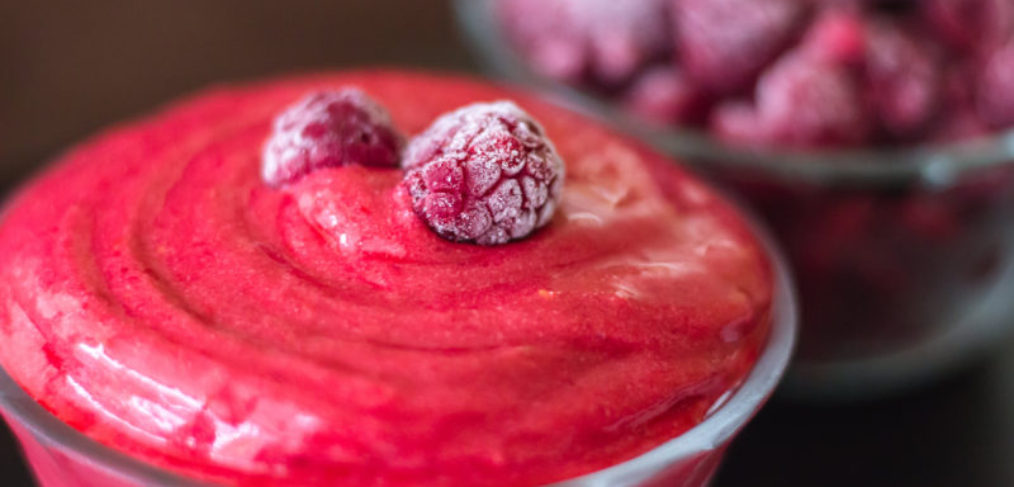
Raspberry Sorbet

Fab and Frosty Treats

Simple and sweet, from whole foods and healthy fats, these soft-serve ice creams whip up in minutes and leave you satisfied, not sick. Bursting with flavor, they need no artificial ingredients to engage your taste buds!

Blend or process until smooth:

  • 1 c. frozen fruit
  • 2 servings of natural fat (such 1 avocado, 1/4 c. nut butter,  or 1/2 c. coconut millk)
  • 1 Tb. citrus juice (or other liquid)
  • 1 Tb. natural sweetener (such as honey, pure maple syrup or coconut sugar)

Winning combinations

  • raspberries, avocado, fresh-squeezed lime juice, and honey
  • peaches, coconut milk, and orange juice concentrate (no sweetener needed)
  • cherries, 1/4 c. almond butter, pomegranate juice (may need water or ice for blending)
  • bananas, cashew butter, almond milk, and pure maple syrup
  • Pineapple; coconut milk; lemon, lime or orange juice; and coconut sugar

Find more treats and satisfying recipes here.

Photo credit: Mordi Photographie