How Much Sugar Is Too Much?

A little indulgence now and then isn’t a bad thing, is it? After all, moderation is a virtue. What’s the harm in having a treat occasionally? Well, that depends on your definition of moderation.

What is Moderation?

To one person, having only 32 ounces of pop per day might sound reasonable, if they’re cutting back from consuming a 6-pack. To another person, having a dessert after dinner might seem excessive if they rarely finish any meal with a treat.

Historically, our use of sugar has climbed almost exponentially from around a few pounds per person annually 200 years ago to nearly 200 pounds per person per year today! So is moderation eating only 100 pounds in a year – a quarter of a pound per day – instead of the  half a pound we’re consuming daily? It seemed excessive  to the rest of the world when the lords and ladies of upper society were putting sugar in their tea at a rate of less than 10 pounds per year during the height of the British Empire.

No, moderation is not the answer to knowing how much sugar to eat because it is such a relative term. Perhaps it would be better to determine your use of sweeteners by whether they are damaging to your health.

Is Sugar Causing Symptoms?

There are times, I’m sure, when you know you’ve had too much sugar, because you feel wired and can’t sleep, or you have a stomach ache, or your acne flares up. But what about those symptoms you can’t see? What if the damage to your body goes undetected for 20 or 30 years? Over-consumption of sweets contributes to the following conditions that take years – sometimes decades – to manifest:

  • Food cravings, addictions, and then, sadly, intolerances.
  • Advanced Glycation End Products, often called AGE’s, which are sticky, cross-linked proteins that create brittle tissues when they are used in the formation of skin, eyes, arteries, and other body parts.
  • Insulin Resistance, an insidious disease that has been implicated in the development of obesity, heart disease, cancer, mineral deficiencies, autoimmunities, hypothyroidism, and other chronic illnesses. You can read more about Insulin Resistance here.

But if you’re eating so much now that it might be causing disease to manifest down the road, you can’t really know in the present.  Therefore, symptoms are not a good gauge of sugar consumption, either!

What If You Just Cut Back a Little?

If you suspect that your sweet tooth has grown too large, you could curtail it a bit. That’s no guarantee that the damage to your body will stop, though. Sugar acts like a drug. How much of an addictive substance can you use without affecting your physiology? There’s also the insulin resistance problem: If a mother has insulin resistance during her pregnancy, she can pass it on to her child, and if that child is female, her eggs are predisposed to insulin resistance, too! So does your cutting back a little reverse the impact of generations?

If you simply didn’t ever eat refined sugar or artificial sweeteners, you obviously wouldn’t need to ask whether you were getting too much. But would you miss it? Well, if a person never takes up gambling, smoking, or drinking, does he feel deprived of addictive behaviors? Of course not! So it is with sweets. Living life without them can be fully satisfying. But you can’t know what it’s actually like unless you do it.

The Real Question

Instead of asking, “How much sugar is too much?” isn’t it better to ask, “How little can I eat?” I challenge you to find out how good life can feel without added sugar.


Open Letter To My Grandson

Dear Grandson,

The other day, you asked me, “Why don’t you believe in eating sugar?”

I told you that I used to be a sugar addict once, but now that I’m on the other side of it, I can see that it simply is not worth it. Yet somehow, that answer isn’t enough. How do I tell you the unseen impact of sugar on your body and your unborn children that does NOT show up for 20 or 30 years?

It’s not about the sugar. It’s about the insulin your body makes every time you eat sweeteners and refined carbohydrates. Insulin is stealthily changing your life – without you even feeling it!

How could you know that insulin makes you anxious? Yes, one of the strongest stimulants of the sympathetic nervous system – the part of your body responsible for putting you into flight-or-flight – is a high level of insulin.

Oh, insulin is definitely needed. While your liver is converting stored fuel to glucose to make sure you never run out of energy, a trickle of insulin circulates to carry that glucose to the cells that use it. But for the first time in the history of mankind, insulin is flooding the body in waves higher than ever before. But since it doesn’t show, how could you know that more than half the population is already insulin resistant, meaning that their cells have “quit listening” to this important messenger.

How could you know that cells which won’t admit insulin’s glucose cargo can’t admit minerals either –  the very minerals that build bones, relax muscles, trigger chemical reactions, and support organ function.

How could you know that high insulin causes cell proliferation? That means it causes cells to multiply abnormally fast. So, it feeds cancer.

How could you know that insulin-instigated cell proliferation creates plaque by causing the cells in your arteries to multiply rapidly? Or that excess insulin causes the blood to clot too readily? Then It changes certain white blood cells, called macrophages, into foam cells – the kind that fill the fatty deposits in your arteries. Step by step, high insulin is giving you heart disease, clogging your arteries, then squeezing them shut.

How could you know that too high insulin keeps your body from making the hormones you need to be a mature young man? That’s because DHEA is needed to produce testosterone, but if there’s too much insulin, a condition called insulin resistance develops. The greater the insulin resistance, the lower your DHEA levels.

How could you know that high insulin will slow down your body’s processes – the rate at which you burn your fuel, warm yourself, grow, and eliminate waste? That’s because your liver is responsible for converting the inactive thyroid hormone into active thyroid hormone. But when the liver becomes insulin resistant, it doesn’t “hear” the instructions from the brain very well, so you become deficient in thyroid hormone.

How could you know that too much insulin causes you to lose important minerals – calcium and magnesium – through your urine? That sets you up for brittle bones, more anxiety, and heart pains called angina.

How could you know that when insulin has been high for a very long time, and insulin resistance has set in, the glucose left in your blood stream makes all the proteins sticky? If those proteins happen to be needed for nerve cells, your nerves won’t function well and you will lose feeling. If those proteins are needed for the collagen that forms muscles, bones, tendons, and skin, these tissues will be weak.

How could you know that chronically high insulin levels reduce your life span through a complex web of processes? One of these is by increasing inflammation in your body. That kind of inflammation is like having a sprained ankle inside your organs all the time.

Finally, how could you know that if you are insulin resistant, your child is many times more likely to be insulin resistant from birth – and if that child is a girl, even her eggs have a higher chance of being insulin resistant?

No, my boy, sugar is not worth it! I don’t believe in eating sugar – and that goes for all modern forms of sweeteners, including high fructose corn syrup and artificial sweeteners. We didn’t have them or need them a thousand years ago. Why now?

I don’t want you to lose your life without knowing your foe. If you believe in eating sugar, then at least know the unseen processes it triggers.

With much love and hope for your future,

Your adoring grandparent.

Build a Balanced Meal

It’s smart to add more fruits and vegetables to your diet and skip the processed food. But can you eat too many plant-based foods? On the other hand, can you eat too much protein or fat? Balance is crucial to avoid metabolic disorders, hormone disruption, blood sugar disruption, and disease.

How Many Vegetables is Enough?

Americans don’t get nearly the quantity of vegetables they should, so more than likely, you’re going to be adding, not subtracting! Aim to fill half your plate with vegetables – both raw and cooked. Raw vegetables will have more vitamins and enzymes, but cooked vegetables will be more digestible and their minerals will be more bio-available. Don’t count starchy ones, like corn, peas, and potatoes. They come under carbohydrates. But do prepare an array of colors – oranges, yellow, purple, red, and green. Pick a variety of vegetables that represent different parts of the plant, such as these:

  • Shoots and stalks:sprouts, asparagus, celery
  • Leaves: lettuces, chard, spinach, beet greens, mustard leaf
  • Buds and flowers: broccoli, cauliflower, cabbage, artichoke
  • Fruits:green beans, cucumbers, tomatoes, squashes, eggplant
  • Roots: turnips, beets, rutabaga, parsnips, onions, garlic, carrots

Can I Get Sufficient Protein on a Vegan Diet?

Protein is tricky. It musn’t be too much or too little, but must be just right – like the porridge in Goldilock’s story. An excess of protein can cause gout and kidney disease. But because protein is what provides the building blocks for your body, if you don’t have enough, you have trouble making hemoglobin (blood cells), hormones (including thyroid), antibodies (to fight disease) and enzymes (the catalysts for every process from digesting to growing.) Even detoxification requires protein.

So try to make 25% of your calories, or at least 1/4 of your plate, protein. Women ought to target 20 grams per meal as a minimum and men would be well-served with at least 30 grams per meal. Those who don’t eat animal products should make a conscientious effort to add up their protein. Yes, quinoa is a high-protein “grain”. But it’s still 4/5 carbohydrate (32 grams carbohydrate, 8 grams protein). The same is true for most legumes. While they contain protein, they are around 75% carbohydrate. One of the best plant proteins would be spirulina, at 2 grams carbohydrate and 4 grams protein per tablespoon. Tofu also rates high in protein – but the processed soy is another story completely!

What is Carb-Loading?

While there are essential fatty acids that the body cannot make and essential amino acids that can only be derived from proteins in the diet, there are no essential carbohydrates. But being carb-free isn’t the answer either, as grains, legumes, nuts, seeds, fruits, and vegetables all have vitamins, antioxidants, and phytonutrients that the body thrives on. The key is to focus on eating carbohydrates in their whole form, as close to nature as possible. Avoid refined sugar, white flour, and other processed forms of carbohydrate. Afterall, real foods don’t come with a label!

If more than 50% of your calories are coming from carbohydrate, you are robbing your body of its need for proteins and fats. I believe that most individuals do very well with no more than 1/4 of their plate coming from starchy carbs: whole grains, legumes, and starchy vegetables. So don’t load up, here!

But Go Easy on the Fat, Right?

Not exactly. Fat is the primary fuel source for your marathoning heart, and the very substance of your brain cells. If you don’t have enough fat, there isn’t a single cell in your body that won’t suffer as it tries to build the membrane around itself that lets nutrients in and siphons wastes out. While carbohydrates provide quick energy, fats provide sustained energy. Be sure to include both saturated and unsaturated types in your diet. But avoid hydrogenated, partially hydrogenated and trans-fats at all costs! Be wary of processed oils that may already be oxidized and rancid. It’s best to stick with unrefined and cold-pressed varieties, especially with those oils that are liquid at room temperature.

A general rule of thumb is to eat a couple of teaspoons of fat for every fist-ful of carbohydrate and palm-ful of protein.

You can learn more about balancing your macronutrients in this class.

5 Way to CUT Your Sugar Cravings!

It isn’t that you’re ignorant of sugar’s impact on your body! It isn’t that your willpower is lacking. It’s that your cravings are bigger than you! There are physiological changes in your body that create eating emergencies. To overcome these effects, you have to work from the inside out, re-programming your body’s sugar responses.

1. Prepare for Craving Crises

When blood sugars drop, you will eat almost anything in sight, and since sugar is readily available and quick, you’re going to grab those convenience store snacks that are so damaging to your health. So plan ahead. Keep an Emergency Kit in your pack, purse or car that includes sugar-stabilizing fats and proteins and slow-burning carbs, such as:

  • jerky
  • nuts and seeds
  • smoked or canned fish
  • snack-pack olives
  • nut butter packets
  • whole grain crackers
  • For short term: hard-boiled eggs, whole fruits, hummus, fresh vegetables (cherry tomatoes, peppers, pea pods, etc.)

2. Hydrate Well!

Sometimes you mistake thirst for hunger. Sometimes you stoke your cravings by feeding your thirst with sweetened beverages or diuretic caffeinated drinks. Beware that for every ounce of soda, energy drink, or coffee that you consume, your body needs TWO ounces of plain water to replenish itself. That is on top of the 70-80 ounces of water a 150-pound person needs daily for normal function. If you are not drinking water regularly, your body cannot digest properly, and that fuels cravings even more by throwing your microbiome (gut bugs) off.

If you don’t like the taste of water straight, add fruit chunks and herbs to it, such as rosemary and peaches, berries and basil, or cucumber and mint.

3. Make Your Meals Like a 3-Legged Stool

Everyone knows that a three-legged stool cannot balance on two legs. Neither can your diet. Don’t go to extremes by eliminating one of the three macro-nutrients: carbs, fats, or proteins. Try to make sure that you eat balanced ratios of each calorically. Although body types and demands differ by lifestyle and genetics, a good rule of thumb is to eat a palmful of protein and a thumb-size portion of natural fat for every cupped handful of carbohydrate. Also eat these foods in their whole forms, as close to nature as possible. Avoid man-made, refined, processed products as much as possible. Source locally and organically where you can. Look for pastured, wild-caught, and free-range.

4. Don’t Feed the Bears!

You can’t get away with just a little sugar and expect that your cravings won’t be triggered. It’s an all-or-nothing deal. Just like an alcoholic who can’t even walk into a bar, you have to STOP eating sugar completely if you’re going to break the addiction. The soda, candy bars, and pastries are obvious foods containing sugar, but watch food labels for sneaky places where sugar might be hiding. About 3/4 of all packaged foods contain added sugar, including some brands of chips. Labels might say dextrose, fructose, sucrose, malt syrup, rice syrup, and barley malt, among other tricky names for added sweeteners.

5. Actively De-Stress

Among my clients, one of their top causes of cravings is stress. But it doesn’t work to passively watch TV or surf the internet to find relief. You have to engage your senses, your thoughts, your breath, and your vagus nerve! If you need some ideas on how to hack your stress, you can check out my online course!

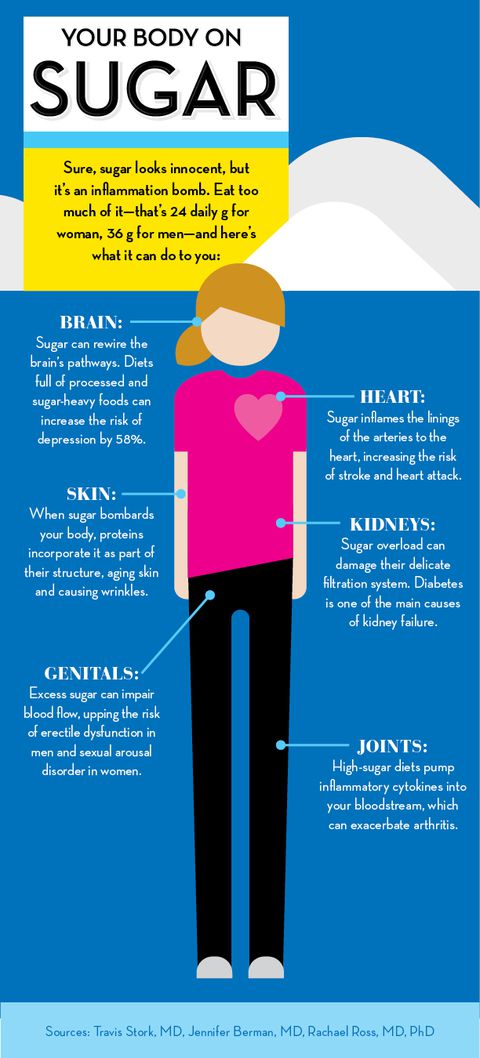
If you need a reminder about why you’re doing this to keep yourself on track, post this infographic on your mirror, your refrigerator, or your cubicle: